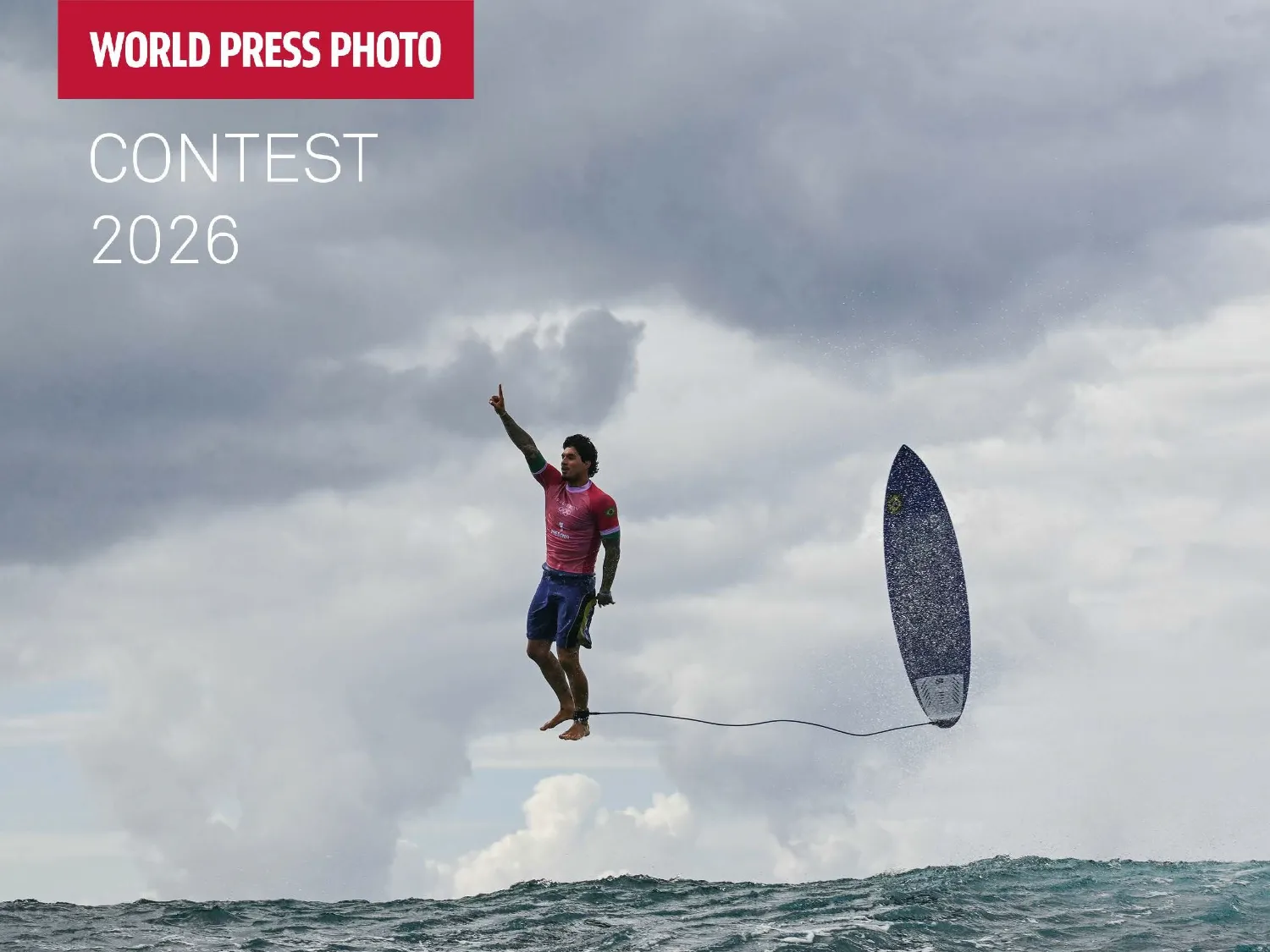
If there is one deadline news and documentary photographers do not want to miss at the start of the year, it is the World Press Photo Contest 2026. The contest is free to enter, aimed at professional photojournalists and documentary photographers worldwide, and awards up to €11,000 to the overall winner, plus global exhibition, publication and industry visibility. Among the many online photography competitions listed on Deartline, this one stands out as a flagship opportunity and one of the most respected free photo competitions in the field of visual journalism.
Entries are judged within six global regions and three format-based categories: Singles, Stories and Long-Term Projects. In total, 42 regional winners each receive €1,000 and extensive exposure through a year-long traveling exhibition visiting more than 80 cities, a multilingual yearbook and online features. From those winners, the global jury selects the World Press Photo of the Year, whose photographer receives an additional €10,000 and FUJIFILM GFX camera equipment. For anyone researching major international photography contests, this is one of the reference names.
The 2026 edition accepts work produced mainly in 2025, with Stories and Long-Term Projects also allowing images from 2024 and earlier years under specific conditions. Submission is handled via Picter, and entries remain free but tightly regulated: entrants must prove their professional status, follow strict rules on manipulation and AI tools, and provide detailed English captions and original files at verification stage. With entries open until 17 January 2026, the World Press Photo Contest 2026 is a key date in the calendar for professional visual storytellers who want their work seen, checked and discussed at the highest level.
Contents
Prizes
The World Press Photo Contest 2026 awards recognition at both regional and global levels, offering financial support, worldwide exposure and professional opportunities. The contest highlights 42 regional winners and one global winner selected from them.
Global Awards
- World Press Photo of the Year: chosen from all regional winners.
- The photographer receives an additional €10,000 (total €11,000 including the regional award).
- The winner and two finalists receive FUJIFILM GFX camera equipment (bodies and lenses).
Regional Winners (42 total)
- Selected across six regions and three categories (Singles, Stories, Long-Term Projects).
- Each regional winner receives €1,000.
- Inclusion in the year-long traveling exhibition shown in 80+ cities worldwide.
- Publication in the annual World Press Photo yearbook.
- A dedicated profile in the World Press Photo collection.
- Promotion across the foundation’s communication platforms.
- Invitation to a winners’ gathering in Amsterdam.
- Official physical award.
Together, these prizes combine cash prizes, global exhibition opportunities, significant publication visibility and high-end equipment awards, making the World Press Photo Contest one of the most influential platforms in professional visual journalism.
Other Free Contests


Categories or Themes
The World Press Photo Contest 2026 is built around three format-based categories rather than subject themes, all focused on photojournalism and documentary storytelling. It is one of the most influential documentary and photojournalism contests, welcoming news coverage, sports, nature and social, political and environmental issues.
- Singles: are single-frame photographs shot in 2025. Every accepted single image is automatically eligible for the World Press Photo of the Year, which makes this category ideal for immediate, decisive moments that define a story in one frame.
- Stories: consist of between four and ten single-frame photographs. Images can be taken in 2024 or 2025, but at least four photographs must be from 2025. All 2025 photographs included in a story are eligible for the World Press Photo of the Year, so carefully editing the sequence is crucial.
- Long-Term Projects: gather between 24 and 30 images around a single theme, produced over at least three different years. At least six photographs must have been shot in 2025, and all 2025 images within the project qualify for consideration as World Press Photo of the Year. This category suits sustained, in-depth reporting and long-running documentary research.
World Press Photo Contest 2026 Dates and Entry Fees
The World Press Photo Contest 2026 runs on a tight but clear calendar. It is free to enter, making it particularly attractive to professionals looking for free photography contests online that also offer strong editorial standards and rigorous judging.
| Entries open | 1 December 2025 |
| Entries close | 17 January 2026 |
| Contest winners announcement | March / April 2026 |
| World Press Photo of the Year and finalists | April 2026 |
| Flagship World Press Photo Exhibition 2026 opening | April 2026, Amsterdam |
There is no entry fee at any stage of the process. However, entrants must budget time to gather proof of professional status and be ready to supply original files (RAW, full-size JPEG or film scans) if their work reaches the later stages of judging and verification.
How to Enter
Entries are submitted through the Picter platform. Photographers first create a personal account, then register specifically for the 2026 World Press Photo Contest, uploading documentation that proves their current professional status in journalism or documentary photography. Once registration has been reviewed and accepted, entrants can upload their photographs, add metadata and write detailed English captions following the contest’s caption guidelines.
Images must be submitted as single-frame JPEG files that meet the contest’s technical requirements, within the correct category and region, before the final deadline on 17 January 2026 at 13.00 CET. Until that time, entrants can edit their submission, but they must remember to re-submit any updated entry so that it is visible to the jury.
About the Jury
The World Press Photo Contest 2026 uses a two-stage jury system that begins with regional juries and concludes with a global jury selecting the 42 regional winners and the World Press Photo of the Year. Each region is evaluated by professionals who work within or originate from that region, ensuring contextual understanding and diversity of perspectives.
Global Jury
- Chair: Kira Pollack (United States), photo director, curator and Harvard Shorenstein Center fellow.
- Joined by the six regional jury chairs, who bring their selections forward to the final round.
- A non-voting secretary oversees the judging process to ensure compliance with the contest rules.
Regional Jury Chairs
- Africa: Tsvangirayi Mukwazhi (Zimbabwe), Associated Press photojournalist.
- Asia Pacific and Oceania: Yasuyoshi Chiba (Japan), AFP.
- Europe: Silvia Omedes (Spain), Photographic Social Vision Foundation.
- North and Central America: Marie Monteleone (United States), Bloomberg News.
- South America: Gael Almeida (Mexico), National Geographic Society.
- West, Central and South Asia: Gabrielle Fonseca Johnson, Reuters Pictures.
This structure balances regional expertise with global oversight, ensuring that the final selection represents a broad, informed and inclusive understanding of journalistic and documentary photography worldwide.
Why Enter World Press Photo Contest 2026?
For professional visual journalists, the World Press Photo Contest 2026 offers a combination that is hard to match: global exhibition in more than 80 cities, publication in a yearbook distributed in several languages, long-term online visibility and focused industry attention. Winners frequently appear in major media outlets and are invited to speak at public events and exhibition openings, which can open doors to new assignments and projects.
Because it is free to enter and strictly limited to professionals, the contest sits in a small group of truly global awards that can shape a career. For photographers browsing Deartline for best photography competitions to enter, this World Press Photo Contest is especially relevant if their work is grounded in real-world stories and they are ready to undergo a rigorous verification process that values accuracy as much as aesthetics.
Rules and Copyright
This section about the rules and image rights of the World Press Photo Contest 2026 has been generated automatically. If you are interested in participating in this contest we suggest you review the complete rules provided by the contest.
Rules
The contest is open only to professional photographers working in journalism and/or documentary photography. Each entrant must supply recent proof of professional status, such as a press card, proof of publication or membership in a recognized association, and team entries must provide proof for every member. All entries must be submitted via Picter, in one of the three categories (Singles, Stories, Long-Term Projects) and in the region where the photographs were taken.
Photographs must be single-frame, single-exposure images that meet the technical requirements (original pixel size, embedded ICC profile, high-quality JPEG upload). Captions and descriptions must be accurate, written in English and provide full contextual information, including dates, locations, subjects and project details. Work from restricted events where only commissioned photographers have access, such as certain government or corporate events, is not accepted.
The contest applies strict rules on manipulation and AI. Content within the frame may not be altered by adding, removing, reversing or distorting people or objects. Entrants whose work progresses are required to provide original files (RAW, full-format JPEG series or unprocessed film scans) so that independent analysts can compare them with the contest images. AI-generated images and generative fill are not allowed, and smartphone images are only eligible when they are shot in standard mode, without creative modes such as HDR or portrait effects.
Copyright and Image Usage
Copyright remains with the photographers or relevant copyright holders. However, for awarded entries, copyright holders grant World Press Photo an unlimited, non-exclusive license to use high-resolution files in all media, including print, online and social media, for activities related to the contest, the traveling exhibition, the yearbook, the public archive and educational or promotional projects connected to the organization, without additional payment.
For non-awarded entries, copyright holders grant a non-exclusive license for low-resolution images to be stored in a non-public archive for educational and research purposes managed by World Press Photo, again without extra remuneration. Entrants are responsible for ensuring that their submissions do not infringe any third-party rights and that any disputes will be handled under Dutch law, with jurisdiction assigned to the courts of Amsterdam.
For more information and to participate in the contest, visit: the official website.